
Accessible Sanitation
ADA Accessible Portable Toilet Rental
Accessible units let wheelchair users and people with mobility aids use the restroom independently. Providers in our network supply ADA-designed units for events, jobsites and public spaces.
One quick call to a real person. You approve the price before anything ships.
- All 50 states + DC
- Price confirmed before delivery
- Pricing explained up front
- 50 + DCStates served
- ADAAccessible units available
- WeeklyTypical servicing for job sites
- 1 day+Event to long-term rentals
What is an ADA portable toilet?
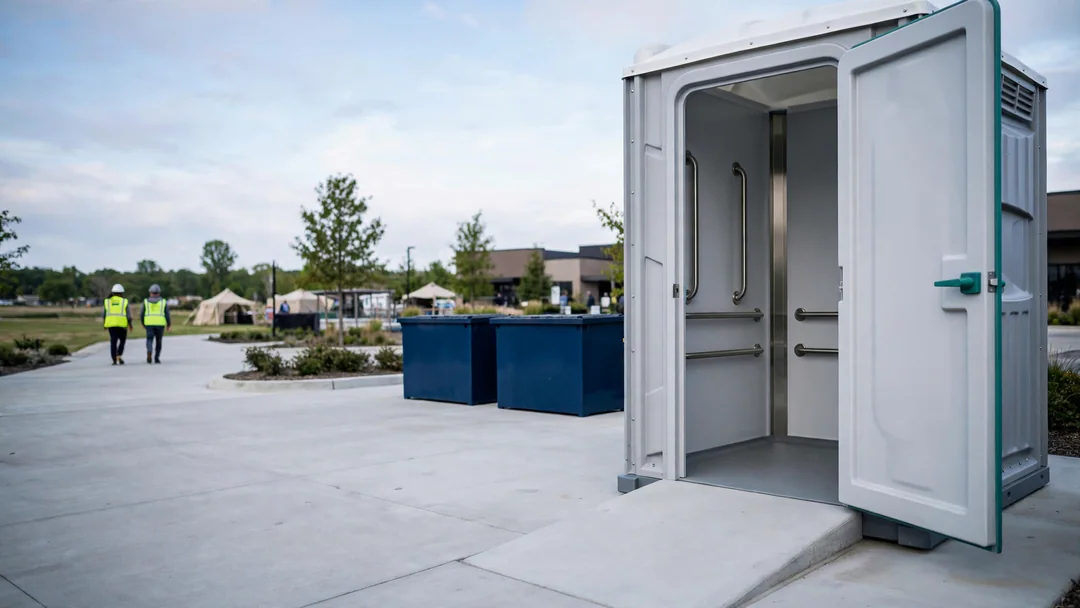
An ADA portable toilet is a larger unit designed to meet accessibility features in the 2010 ADA Standards for Accessible Design: a level or ramped entry, a wide door, interior space for a wheelchair to turn (commonly a 60-inch turning circle), grab bars and an accessible seat height. Specific features vary by model, so confirm the unit details with your provider.
Why accessible units matter
When portable toilets are provided for the public or for employees, people with disabilities need to be able to use them too. A standard unit is too small for a wheelchair and usually has a step at the door. An accessible unit solves that with a larger footprint, ground-level entry and an interior layout that allows a wheelchair user to enter, turn, transfer and close the door.
Accessible units are not only for wheelchair users. Parents with small children, people using walkers or canes, and anyone who needs more room tend to choose them, so they often get steady use at events.
What the 2010 ADA Standards point to
The 2010 ADA Standards for Accessible Design are the main federal reference for accessible facilities. For portable toilets, commonly cited guidance is that where portable units are clustered at a single location, at least 5 percent of them, and no fewer than one, should be accessible. Event permits, venue contracts and state or local codes may set their own requirements, so confirm what applies to your situation with the permitting authority.
| Units in a cluster | Accessible units (minimum) |
|---|---|
| 1 to 20 | 1 |
| 21 to 40 | 2 |
| 41 to 60 | 3 |
| 61 to 80 | 4 |
Key accessible features
Accessible units differ by manufacturer, but you should expect most of the following. Ask your provider for the specific model so you can confirm it meets your needs.
- Level entry: a floor at or near ground level, or a short integrated ramp, with no step.
- 60-inch turning space: interior room commonly designed for a wheelchair to make a full turn.
- Grab bars: mounted beside and behind the toilet to help with transfers.
- Wide door: with hardware that can be operated without tight grasping or twisting.
- Accessible seat height and controls: paper and sanitizer within reach from a seated position.
Placement and an accessible route
An accessible unit only helps if people can reach it. Place it on firm, level ground, connected to the main area by a stable path without steps, deep gravel, loose sand or steep grades. Avoid putting it at the far end of a bank where the approach crosses uneven ground or cables. At events, consider placing accessible units closest to parking, seating or the main walkway, and sign them clearly.
Keep the area in front of the door clear so a wheelchair can approach and turn. Mats or temporary ground cover can help on grass that will get soft if it rains.
Accessible units on jobsites
Construction sites with employees or visitors who need accessible facilities should include an accessible unit. It is also useful for supervisors, inspectors and clients touring a site. Coordinate placement so the route stays usable as the site changes, and tell the provider if the unit needs to move. See construction porta potties for jobsite planning.
Common mistakes to avoid
Most accessibility problems with portable restrooms come from planning, not equipment. The unit itself may be well designed, but placement and logistics determine whether it actually works for the person who needs it.
- Placing the accessible unit on a slope, in a ditch or on soft sand.
- Blocking the door approach with trash cans, hand washing stations or cables.
- Locating it far from parking, seating or the main entrance.
- Relying on a restroom trailer with steps as the only facility.
- Forgetting signage, so guests do not know an accessible unit exists.
- Ordering only one accessible unit for a very large, clustered restroom area.
Questions to ask your provider
Before booking, ask which model they will deliver, its exterior footprint and interior dimensions, whether entry is level or ramped, where the grab bars are mounted, and whether the door hardware is easy to operate. Also ask how they handle placement on grass or gravel and whether they can bring mats or a level pad if needed. Clear answers now prevent problems on the day.
Service and requesting a quote
Accessible units are serviced the same way as other units, with pumping, cleaning and restocking on a schedule. Ask the technician to keep the approach clear and check grab bars and door hardware. When you request a quote, include the total number of units, how many accessible units you want, the site surface and any permit requirements. Prices vary by market and provider; see pricing factors.
Frequently asked questions
How many ADA porta potties do I need?
Commonly cited guidance is at least 5 percent of clustered units, with a minimum of one. Your permit, venue or local code may require more, so confirm locally.
Are ADA units bigger than standard units?
Yes. They have a larger footprint to fit a turning space, so allow extra room when planning the layout and truck access.
Can a restroom trailer count as accessible?
Only if it has an accessible stall and entry, such as a ramp or lift. Many trailers have steps, so confirm with the provider before relying on one.
Do I need an accessible unit for a private party?
Requirements are clearer for public events and workplaces, but if any guest may need one, it is the considerate choice. Ask guests ahead of time when possible.
Do all ADA units have the same features?
No. Features vary by manufacturer and model. Ask the provider for the specific unit and its features before you book.
Related pages
Need portable toilets on site?
Share your ZIP code and project details. We will route it to an available provider near you.